Filed under: #Blog#Design
Stone in Hospitality Design: Where Every Surface Is a First Impression
In hospitality design, there are no neutral decisions. Every material choice is experienced by hundreds of guests before most design decisions are even noticed: the floor beneath their feet the moment they walk in, the wall beside the staircase they pause at, the counter they rest their hand on at check-in. These are the surfaces…
In hospitality design, there are no neutral decisions. Every material choice is experienced by hundreds of guests before most design decisions are even noticed: the floor beneath their feet the moment they walk in, the wall beside the staircase they pause at, the counter they rest their hand on at check-in. These are the surfaces that establish the register of a space before the menu, the lighting, or the staff ever get a chance.
Natural stone earns its place in this category precisely because it communicates without effort. It signals craft, investment, and permanence, qualities that guests absorb instinctively, even when they can’t articulate why the space feels the way it does. The best hospitality projects treat stone not as a finish material but as a foundational design decision.
The projects below demonstrate what that looks like in practice.
The Gem Hotel New York
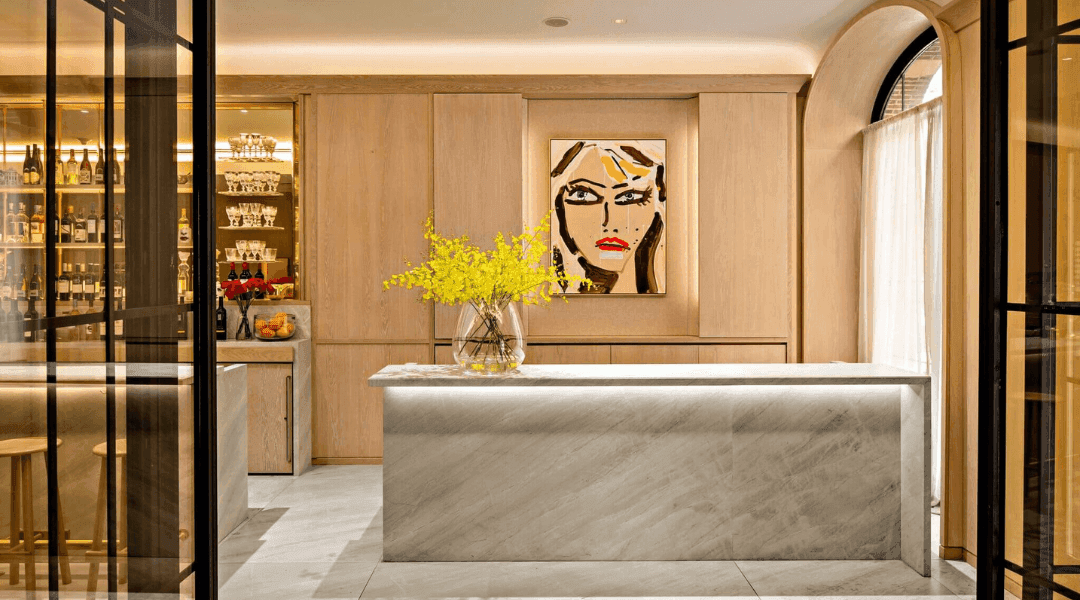
The first physical interaction a guest has with a space is among the most consequential moments a designer controls. At the Gem Hotel in New York, designed by Paris Forino, that moment belongs to our Taj Mahal quartzite. It is the first thing you touch when you check in, a counter material chosen for both its warmth and its quiet authority.

Taj Mahal’s soft, luminous ground and delicate veining create an immediate sense of refinement without demanding attention. It is a material that rewards proximity: the closer you get, the more considered it feels.
Hotel Del Coronado San Diego
At the iconic Hotel Del Coronado in San Diego, designed by Leo A Daly Dallas, the material choice operates at a different scale but with the same intentionality. The stone’s subtle veining and cool tone carry the coastal character of the property while holding their own against a landmark building that has been welcoming guests since 1888. Specifying material for a historic property means the stone cannot simply look good on day one; it has to belong to the building’s story.

The Floor as the Protagonist
In restaurant and dining environments, the floor often does more compositional work than any other surface. It is the backdrop against which everything else (furniture, light, people) reads. The right material selection at the floor level can anchor a space and define its character before a single guest is seated.
Torrisi New York City

At Torrisi in New York City, designed by Garrett Singer Design for Major Food Group, Stone Source materials ground the floors of one of the city’s most closely watched dining rooms. The setting demands a material that can hold its own in a high-energy environment without competing with the energy in the room. Stone, with its natural variation and depth, absorbs light and activity in a way that manufactured surfaces cannot replicate.
25Hours Hotel Piazza San Paolino
At 25Hours Hotel Piazza San Paolino in Florence, designer Paola Navone took a more explicit approach. Working within a 15th-century convent, she layered centuries of architecture and introduced a checkerboard floor in Stone Source’s La Pietra Compattata Cromie collection, in Nero and Verde Abete. The choice is confident and deliberate: a graphic material gesture that holds its ground against the weight of the building’s history rather than deferring to it. It is the kind of move that only works when the material is right, and La Pietra Compattata Cromie, with its deep tonal character and compressed stone quality, earns it.
The Architectural Feature
Some stone placements are not about coverage. They are about a single gesture that sets the tone for everything else in the space.
La Padrona Restaurant Boston, Massachusetts

At La Padrona in Boston, designed by AvroKO, that gesture is the staircase. Milky White Travertine wraps an architectural feature that functions as the visual centerpiece of the restaurant before dinner service even begins. The natural movement in the stone enhances the sculptural form of the stair, creating a focal point that communicates grandeur through material rather than ornamentation. Travertine’s depth and variation mean no two slabs read the same way, which gives a feature installation like this a hand-finished quality that millwork or painted plaster cannot achieve.
Outdoor Hospitality
Foothill Sanctuary Boulder, Colorado

The hospitality experience increasingly extends beyond the building’s envelope. At Foothills Sanctuary in Boulder, Colorado, Patagonia quartzite brings the material language of the interior into the landscape, maintaining the quality threshold of the project in an outdoor context where lesser materials would compromise it. Stone that can perform in Colorado’s climate while holding an elevated aesthetic is a specific specification challenge, and quartzite’s natural density and durability make it one of the few materials genuinely suited to both.
Specifying Stone for Hospitality
The through line across these projects is not a single material or aesthetic. It is the standard of care applied to the specification. Hospitality projects see more foot traffic, more physical contact, and more critical eyes than almost any other building type. The materials have to perform at every level: visually, technically, and experientially.
Stone Source works directly with designers and architects on hospitality specifications, from initial material selection through slab sourcing and project fulfillment. To explore materials for your current project, contact a Stone Source representative or request samples through your nearest showroom.