Filed under: #Blog#Design
Why Outdoor Pavers Are Having Their Architectural Moment
Outdoor surface design and outdoor pavers have never been more important, and it’s a part of the design process that has historically been overlooked. The interior has always received the editorial treatment. The marble, the wide-plank oak, and the curated stone, while the complementary outdoor space was secondary and less of a focus in both…
Outdoor surface design and outdoor pavers have never been more important, and it’s a part of the design process that has historically been overlooked. The interior has always received the editorial treatment. The marble, the wide-plank oak, and the curated stone, while the complementary outdoor space was secondary and less of a focus in both residential and commercial design. That hierarchy is dissolving – fast. The terrace, the courtyard, the pool deck, the rooftop: these are no longer secondary rooms. They are the rooms, and they deserve the same material rigor as anything that lives indoors.
Spring is when the conversation begins, and the decisions made now will determine how a property reads from May through October. Below, we’ll take a closer look at where outdoor pavers are heading, the materials worth specifying, and how the most considered projects are using surface to dissolve the line between inside and out.
Continuity, Not Contrast
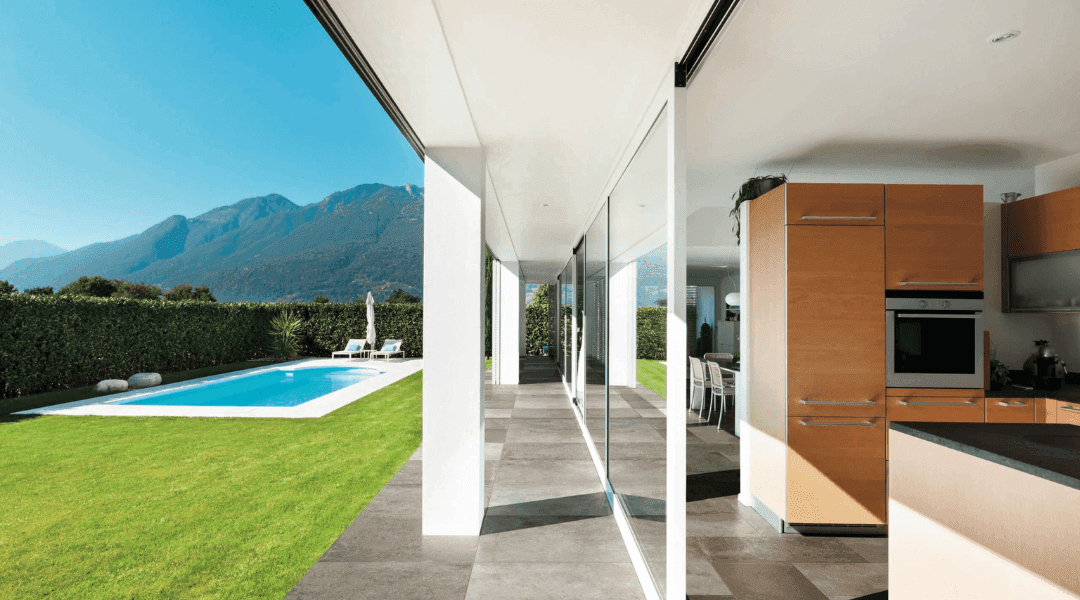
The most quietly luxurious move in commercial design right now is also the most disciplined: choosing one material, in two finishes, to run from the lobby to the terrace. A polished porcelain inside, a structured anti-slip outside, both drawn from the same color and pattern. The eye reads it as continuity. Thresholds disappear. The courtyard becomes an extension of the floor plate rather than a separate zone at the edge of it.
This kind of indoor-outdoor coherence has been an architectural ambition in hospitality and high-end retail for decades. What’s new is that the materials finally support it at scale. A 20mm porcelain paver, dimensionally matched to a 10mm interior tile, allows for the same visual surface across two structural conditions, whether that’s a hotel pool deck reading into a spa corridor, a restaurant patio flowing from the dining room, or a flagship entry that holds its line from sidewalk to sales floor. The technical detail is invisible. The result is a project that reads as one continuous and intentional gesture.
VIEW OUR OUTDOOR PAVER COLLECTIONS.
Porcelain Has Rewritten the Category
The case for porcelain pavers is now well-established and worth restating clearly. The material is rated for freeze-thaw without sealing. It doesn’t fade under UV. It resists chlorine and salt, and it carries an R11 slip rating in textured finishes. It can be installed dry-laid on gravel, on adjustable pedestals over a roof membrane, or set traditionally in mortar. One paver, four installation methods, every climate.
For the trade, this changes the calculus on rooftop terraces, especially. A pedestal-set porcelain system creates a perfectly level deck over an irregular substrate, allows water to drain freely beneath, and remains fully accessible for membrane inspection. For homeowners, the same product erases the maintenance ledger that comes with sealed limestone or stained wood.

When Natural Stone Still Wins
None of this is an argument against natural stone outside. Bluestone, travertine, basalt, granite: each carries a tactile depth that porcelain can reference but not entirely replicate. A travertine pool deck, properly specified and detailed, ages into something porcelain cannot mimic. The grain shifts with the weather. The color deepens. The surface becomes a record.
The question is no longer porcelain versus stone. It is the material that serves the project’s brief, its climate, and its maintenance posture. A weekend house in the Hamptons that closes for winter has different demands than a year-round residence in the desert. A commercial courtyard with heavy footfall asks different things than a private terrace. The catalog has expanded so that the answer is almost always available; the discipline is in the specifying.
VIEW OUR NATURAL STONE COLLECTIONS.
The Palette is Shifting Toward the Ground
A note on color, because it matters more than the trade press has caught up to. The dominant outdoor palette is moving away from the gray-on-gray bluestone vocabulary that defined the last decade, and toward warmer, more variable territory. Limestone tones with rust and iron. Travertine in honey and walnut. Porcelain pavers that reference Pietra Serena, Yorkstone, and weathered terracotta. The garden is a continuation of the earth itself rather than a contrast to it.
This pairs naturally with the broader movement back toward warmth in interiors, and it solves a longstanding tension in pool design specifically: cooler-toned stone reads cold in the shoulder seasons, while a warmer paver holds its appeal from April through October.
How to Begin
The work of selecting an outdoor surface happens in person. Slip rating, scale, color variation, edge profile: these are touch-and-light decisions, not screen ones. The best place to start is a showroom visit, where the full sample library is in arm’s reach, and a specialist can walk through application, installation, and the technical details that determine whether a deck still performs in five years.
Stone Source maintains showrooms across the country, each stocked with the full outdoor library: porcelain pavers, natural stone, and dimensional cut. The patio deserves the same consideration as the living room this year. It always should have.